Doctoral thesis details
Childhood Adversity and Insomnia in Later Life: Can Social Capital Help?
Introduction
Sleep is an important part of a healthy lifestyle. A meta-analysis of prospective studies reported an association between sleep duration and all-cause mortality (Cappuccio et al., 2010). In Japan, approximately one in three older adults has a sleep disorder (Watanabe et al., 2020), so improving sleep in later life is a public health priority.
Adverse childhood experiences (ACEs) have recently received attention as risk factors for sleep disorders. As part of my doctoral research, I examined this issue from the viewpoint of social capital, that is, the resources found in people's connections with others. This article summarizes the background, the main findings, and how to interpret them.
What are ACEs?
ACEs are stressful or traumatic experiences before the age of 18, such as abuse, neglect, and household dysfunction. A large U.S. study (Felitti et al., 1998) showed that childhood abuse and household dysfunction were associated with many of the leading causes of death in adults. ACEs are not rare. At least one ACE was reported by 63.9% of U.S. adults (Swedo et al., 2023) and by 67% of older adults in Japan (Matsukura et al., 2023).
ACEs and sleep: what we already know
ACEs are linked to depression, ischemic heart disease, premature mortality, and sleep disorders. A systematic review and a meta-analysis of cohort studies both suggest that people with ACEs are more likely to have sleep problems (Kajeepeta et al., 2015; Yu et al., 2022). Emotional neglect and emotional abuse have been consistently associated with insomnia, and a larger number and diversity of ACEs appear to increase the risk of sleep disturbances (Bader et al., 2007; Wang et al., 2016).
Both biological and social pathways have been proposed. Biologically, childhood adversity has been associated with fragmented rapid eye movement sleep and increased nighttime arousals (Bader et al., 2007; Insana et al., 2012), and with epigenetic changes in stress-related genes that may heighten stress reactivity throughout life (Van Someren, 2021). Socially, people with ACEs may be exposed to stressors throughout life, which may degrade sleep (Kajeepeta et al., 2015; Greenfield et al., 2011).
Can social capital help?
Is the influence of ACEs unavoidable? Here, we focused on social capital. The sociologist Bourdieu described it as resources embedded in social relations, and Putnam later popularized it in public health as features of social organization, such as trust, norms, and networks. It is often organized into cognitive dimensions (e.g., trust and reciprocity) and structural dimensions (e.g., social participation and networks) (Kawachi & Berkman, 2000). Higher social capital has been associated with better health, and one study has examined its relation with sleep duration in older adults (Yang et al., 2022).
Social capital may also buffer the link between ACEs and poor health. Among people with a history of child abuse, strong social relationships were related to a lower risk of mental illness (Afifi et al., 2016), and a study of dementia in the same cohort as ours also examined the role of social capital among people with ACEs (Tani et al., 2021).
However, social capital may not always be protective. ACEs may affect brain regions involved in emotion processing, which may make interpersonal relationships difficult and limit the use of social capital (Teicher et al., 2016). Violence can also be passed across generations (Koga et al., 2024), and social relationships may reproduce adversity. Therefore, we need to pay attention to the "dark side" of social capital (Portes, 1998; Villalonga-Olives & Kawachi, 2017). In short, social capital might buffer the effect of ACEs, but in some contexts it might amplify it.
To our knowledge, no study had examined whether social capital modifies the association between ACEs and insomnia among older adults. We therefore aimed (1) to examine the association between ACEs and insomnia and (2) to test effect-measure modification (EMM) by social capital. Following a previous study (Saito et al., 2017), we measured social capital in three dimensions: civic participation, social cohesion, and reciprocity. We expected that the three dimensions might work differently.
How we studied it
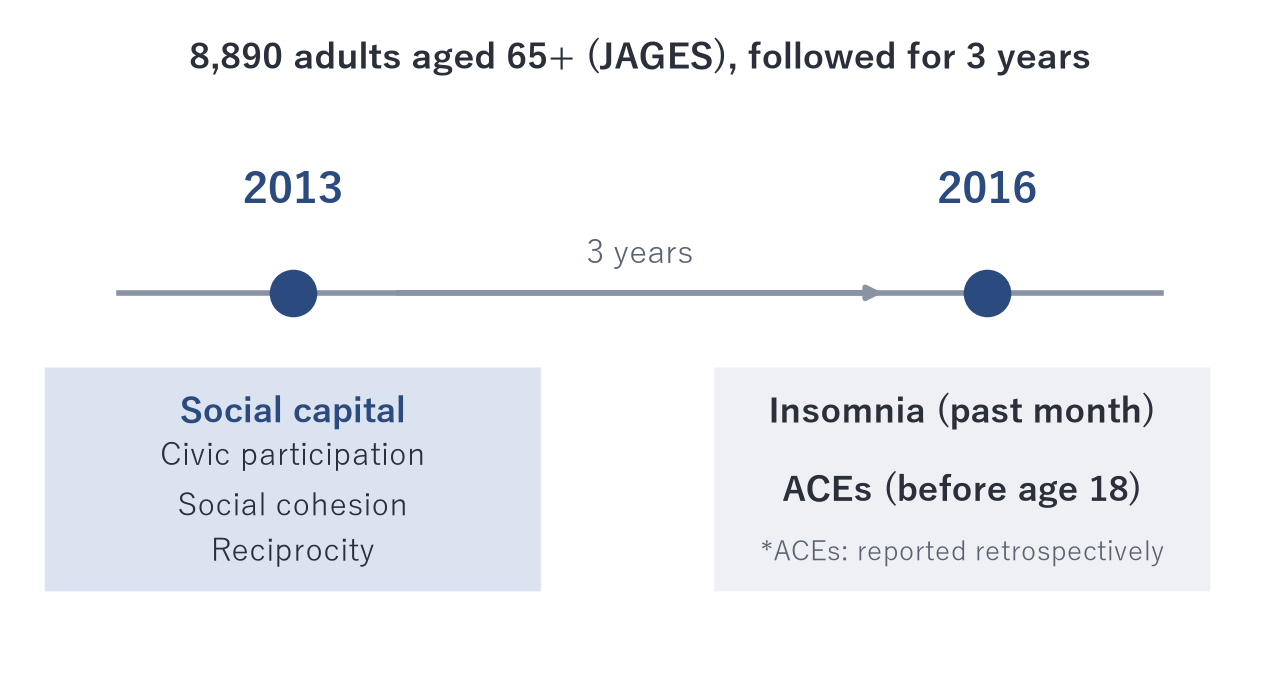
We used data from the Japan Gerontological Evaluation Study (JAGES) (Kondo & Rosenberg, 2018), a mail survey of adults aged 65 years and older in municipalities across Japan. Our analysis included 8,890 participants who answered the questions in both 2013 and 2016.
Insomnia was assessed in 2016 using the Japanese version of the Athens Insomnia Scale (Okajima et al., 2013), which asks about symptoms in the last month. A score of 6 or higher (out of 24) was defined as insomnia. This is a screening cutoff, not a clinical diagnosis. ACEs were also reported in 2016, retrospectively, for the period before age 18. The eight items were parental loss, parental divorce, parental mental illness, father violence toward mother, being hit by a parent hard enough to cause an injury, not feeling loved by parents, harsh words or insults from parents, and childhood poverty. We summed the items. Social capital was measured in 2013: civic participation was the number of types of groups (e.g., sports, hobby, and volunteer groups) in which participants took part at least monthly; social cohesion was based on trust in neighbors, helpfulness of community members, and attachment to the community; and reciprocity was based on receiving and providing support, such as having someone to listen to one's concerns. Social capital was therefore measured before insomnia.
We estimated the relative risk (RR) of insomnia using modified Poisson regression, adjusting for age, gender, income, education, chronic disease, smoking, drinking, and other factors (Model 1). We tested EMM on both the multiplicative and additive scales. Because depressive symptoms may be both a confounder and a mediator, Model 2 additionally adjusted for them.
Result 1: More ACEs, more insomnia
Of the 8,890 participants, 32% reported no ACEs, 33% one, 18% two, and 6% three or more (the rest had missing ACE data). Participants with more ACEs were more likely to have a low income and low education. Among those with available data, 41% of those with no ACEs and 62% of those with three or more had an annual income below 2 million yen, and 28% and 62%, respectively, had fewer than 10 years of education. Their social capital scores were also lower on average.
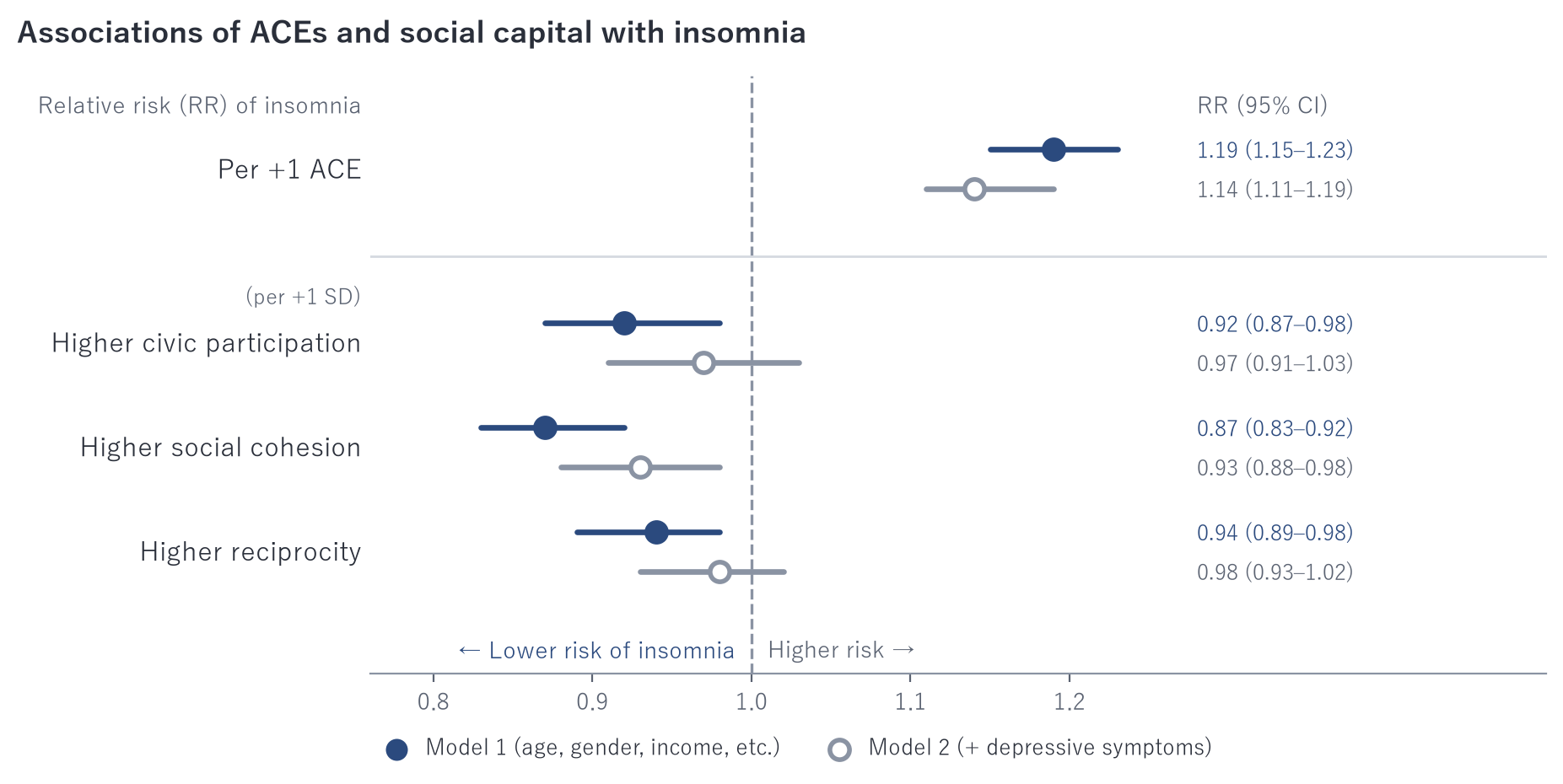
Insomnia was reported by 19% of participants with no ACEs and 35% of those with three or more (unadjusted; among those with insomnia data). After adjustment for covariates, the RR of insomnia per additional ACE was 1.19 (95% CI: 1.15, 1.23). The association remained after additional adjustment for depressive symptoms (RR = 1.14; 95% CI: 1.11, 1.19).
Result 2: Higher social capital, less insomnia
Higher social capital was also associated with a lower probability of insomnia. Per 1-SD increase, the RRs were 0.92 for civic participation, 0.87 for social cohesion, and 0.94 for reciprocity. After adjusting for depressive symptoms, the associations for civic participation and reciprocity were no longer clear, while that for social cohesion remained (RR = 0.93; 95% CI: 0.88, 0.98).
Result 3: Did social capital modify the ACE–insomnia association?
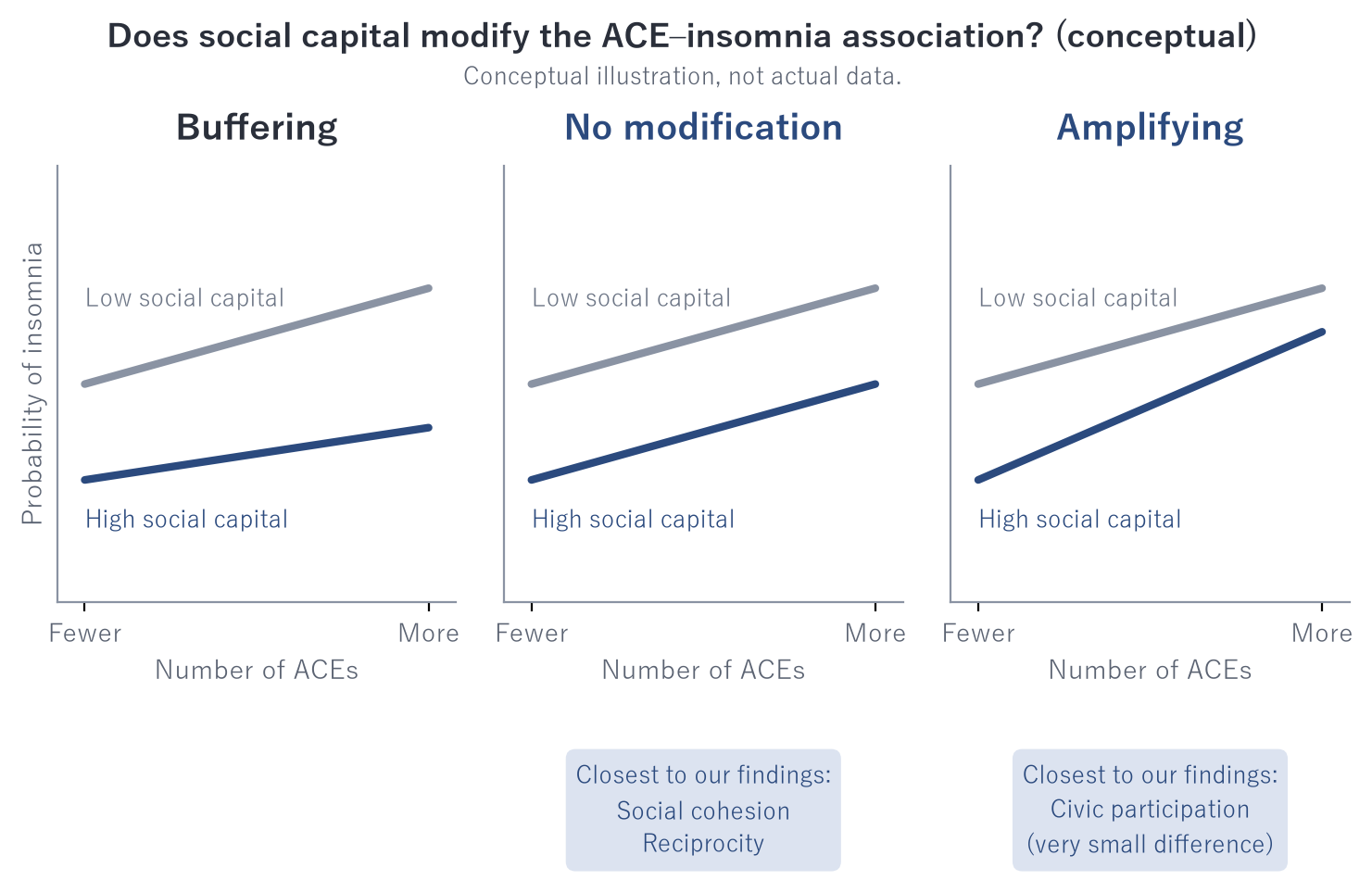
For our main question, the answer was that evidence for modification was limited. For social cohesion and reciprocity, the ACE–insomnia association was almost the same at high and low levels of social capital. For civic participation, the association was slightly stronger among those with higher participation (multiplicative RR = 1.04 per ACE; p = 0.03). The difference was small, and its statistical significance depended on the analytic specification. We should not read this as "civic participation is harmful."
How to interpret the results
The association between ACEs and insomnia is consistent with previous studies. Persistent hyperarousal, as proposed in a model of trauma-induced chronic insomnia (Werner et al., 2021), may partly explain it.
For civic participation, we speculated that people with ACEs may feel social strain in participation settings (Chung, 2017). This is only a hypothesis and was not tested in our study. For social cohesion, the positive aspects, such as trust and perceived safety, may be offset by conformity pressure (Villalonga-Olives & Kawachi, 2017) and reputational concerns (Huang et al., 2025). Even so, social cohesion was associated with less insomnia regardless of ACE history, which may be meaningful for older adults with ACEs.
A previous study on dementia in the same cohort reported EMM (Tani et al., 2021), which differs from our results. The difference may reflect the nature of the outcomes (dementia is a long-term cumulative condition, while insomnia is a shorter-term psychological and behavioral one), the timing of measurement, and the effect scale.
In practice, when promoting participation, we should pay attention to quality, such as psychological safety, and not only to quantity, while also strengthening community cohesion. In Japan, community gathering places (kayoi-no-ba) are being evaluated, and a study reported their association with healthy longevity, particularly among socioeconomically disadvantaged people (Ide et al., 2025). Whether such initiatives reduce insomnia remains to be tested.
Conclusions
In summary, older adults with more ACEs were more likely to have insomnia, and those with higher social capital were less likely to have insomnia. Social cohesion remained associated with lower risk of insomnia after adjustment for depressive symptoms. However, evidence for effect-measure modification was limited: social cohesion and reciprocity showed no clear modification, and civic participation showed a small difference in the amplifying direction. Because this is an observational study, we cannot show causal relationships.
Experiencing ACEs may be related to later sleep problems, but it does not determine one's future. Future research should examine whether strengthening social cohesion and promoting psychologically safe participation can support sleep health among older adults, including those with ACEs.
I am deeply grateful to all the JAGES participants.
This article summarizes a research study and is not individual medical advice.
Article information
Tomono N, Hanazato M, Kondo K, Ide K, Nakagomi A. Associations between adverse childhood experiences and insomnia: The moderating role of social capital in a three-year longitudinal study from the Japan Gerontological Evaluation Study. Preventive Medicine Reports. 2025. https://doi.org/10.1016/j.pmedr.2025.103319
References
- Afifi TO, MacMillan HL, Taillieu T, Turner S, Cheung K, Sareen J, Boyle MH. Individual- and relationship-level factors related to better mental health outcomes following child abuse: results from a nationally representative Canadian sample. Can J Psychiatry. 2016;61(12):776-788.
- Bader K, Schäfer V, Schenkel M, Nissen L, Schwander J. Adverse childhood experiences associated with sleep in primary insomnia. J Sleep Res. 2007;16(3):285-296.
- Cappuccio FP, D'Elia L, Strazzullo P, Miller MA. Sleep duration and all-cause mortality: a systematic review and meta-analysis of prospective studies. Sleep. 2010;33(5):585-592.
- Chung J. Social support, social strain, sleep quality, and actigraphic sleep characteristics: evidence from a national survey of US adults. Sleep Health. 2017;3(1):22-27.
- Felitti VJ, Anda RF, Nordenberg D, Williamson DF, Spitz AM, Edwards V, Koss MP, Marks JS. Relationship of childhood abuse and household dysfunction to many of the leading causes of death in adults. Am J Prev Med. 1998;14(4):245-258.
- Greenfield EA, Lee C, Friedman EL, Springer KW. Childhood abuse as a risk factor for sleep problems in adulthood: evidence from a U.S. national study. Ann Behav Med. 2011;42(2):245-256.
- Huang K-J, Uchida Y, Takemura K, Fukushima S, Aida J, Hanazato M, Kanamori M. Paradoxical effects of community social cohesion on mental health and help-seeking among older adults: the role of reputation concern and socioeconomic status. Soc Sci Med. 2025;380:118234.
- Ide K, Kawaguchi K, Watanabe R, Shibata A, Matsumura K, Tsuji T, Kondo K, Nakagomi A. Heterogeneity in the associations of community gathering place participation with healthy ageing. Arch Gerontol Geriatr. 2025;106060.
- Insana SP, Kolko DJ, Germain A. Early-life trauma is associated with rapid eye movement sleep fragmentation among military veterans. Biol Psychol. 2012;89(3):570-579.
- Kajeepeta S, Gelaye B, Jackson CL, Williams MA. Adverse childhood experiences are associated with adult sleep disorders: a systematic review. Sleep Med. 2015;16(3):320-330.
- Kawachi I, Berkman L. Social cohesion, social capital, and health. In: Social Epidemiology. New York: Oxford University Press; 2000. p.174-190.
- Koga C, Tsuji T, Hanazato M, Nakagomi A, Tabuchi T. Intergenerational chain of violence, adverse childhood experiences, and elder abuse perpetration. JAMA Netw Open. 2024;7(9):e2436150.
- Kondo K, Rosenberg M, editors. Advancing Universal Health Coverage through Knowledge Translation for Healthy Ageing: Lessons Learnt from the Japan Gerontological Evaluation Study. World Health Organization; 2018.
- Matsukura H, Yamaoka Y, Matsuyama Y, Kondo K, Fujiwara T. Association between adverse childhood experiences and marital status among Japanese older adults. Child Abuse Negl. 2023;144:106340.
- Okajima I, Nakajima S, Kobayashi M, Inoue Y. Development and validation of the Japanese version of the Athens insomnia scale. Psychiatry Clin Neurosci. 2013;67(6):420-425.
- Portes A. Social capital: its origins and applications in modern sociology. Annu Rev Sociol. 1998;24(1):1-24.
- Saito M, Kondo N, Aida J, Kawachi I, Koyama S, Ojima T, Kondo K. Development of an instrument for community-level health related social capital among Japanese older people: the JAGES project. J Epidemiol. 2017;27(5):221-227.
- Swedo EA, Aslam MV, Dahlberg LL, Niolon PH, Guinn AS, Simon TR, Mercy JA. Prevalence of adverse childhood experiences among U.S. adults: Behavioral Risk Factor Surveillance System, 2011-2020. MMWR Morb Mortal Wkly Rep. 2023;72(26):707-715.
- Tani Y, Fujiwara T, Kondo K. Adverse childhood experiences and dementia: interactions with social capital in the Japan Gerontological Evaluation Study cohort. Am J Prev Med. 2021;61(2):225-234.
- Teicher MH, Samson JA, Anderson CM, Ohashi K. The effects of childhood maltreatment on brain structure, function and connectivity. Nat Rev Neurosci. 2016;17(10):652-666.
- Van Someren EJW. Brain mechanisms of insomnia: new perspectives on causes and consequences. Physiol Rev. 2021;101(3):995-1046.
- Villalonga-Olives E, Kawachi I. The dark side of social capital: a systematic review of the negative health effects of social capital. Soc Sci Med. 2017;194:105-127.
- Wang Y, Raffeld MR, Slopen N, Hale L, Dunn EC. Childhood adversity and insomnia in adolescence. Sleep Med. 2016;21:12-18.
- Watanabe M, Shobugawa Y, Tashiro A, Ota A, Suzuki T, Tsubokawa T, Kondo K, Saito R. Association between neighborhood environment and quality of sleep in older adult residents living in Japan: the JAGES 2010 cross-sectional study. Int J Environ Res Public Health. 2020;17(4):1398.
- Werner GG, Riemann D, Ehring T. Fear of sleep and trauma-induced insomnia: a review and conceptual model. Sleep Med Rev. 2021;55:101383.
- Yang L, Wang H, Cheng J. Association between social capital and sleep duration among rural older adults in China. BMC Public Health. 2022;22(1):12.
- Yu H-J, Liu X, Yang H-G, Chen R, He Q-Q. The association of adverse childhood experiences and its subtypes with adulthood sleep problems: a systematic review and meta-analysis of cohort studies. Sleep Med. 2022;98:26-33.